Parking in Kotor and Budva: Where to Park and What to Avoid
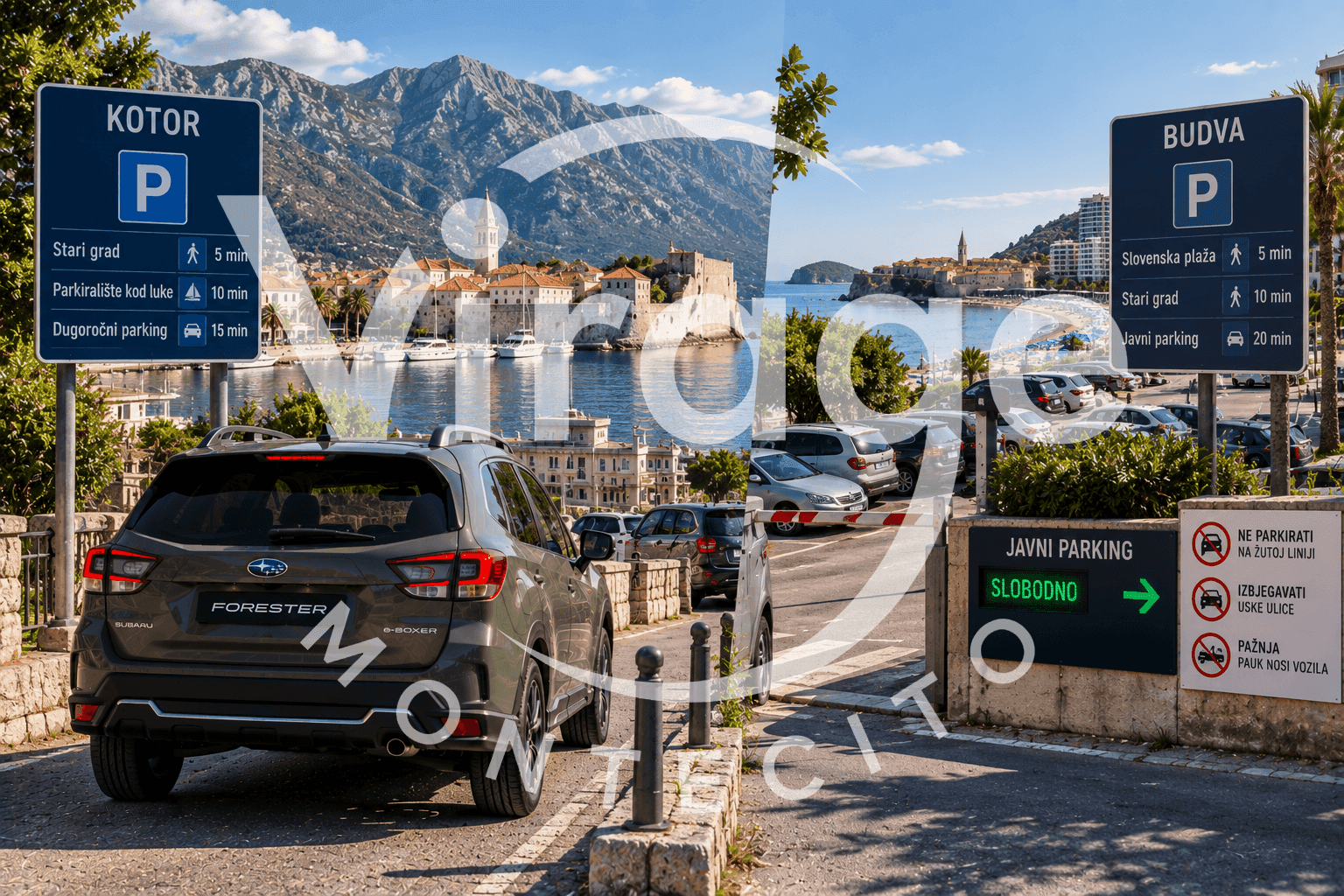
The old towns of Kotor and Budva are pedestrian zones with no vehicle access for visitors — which makes parking one of the first practical questions for anyone touring the coast by car.
Parking in Kotor
The main parking areas sit outside the town walls, near the bus station and the cruise ship port. Lots charge by the hour, with rates climbing during the summer months. The walk from a lot to the old town entrance is usually short — five to ten minutes.
Parking in Budva
Budva works much the same way — the old town is closed to traffic, and the nearest lots sit along the promenade and near the marina. In summer these fill up fast, especially in the afternoon and evening when crowds peak.
Types of parking in both towns
Kotor and Budva have a few different kinds of parking: larger organized lots charging by the hour or day, smaller private lots run by local accommodation hosts or restaurants, and street parking in zones outside the pedestrian area, usually the cheapest but also the most limited in space. The larger organized lots are the safest option for a longer stay, since they're usually enclosed and staffed.
Longer-stay parking
If you're planning to stay in Kotor or Budva for several days, ask about the daily or weekly rate — many of the bigger lots offer a better rate for a longer stay compared with paying by the hour. This is especially useful if you only plan to use the car for trips out of town and will spend most of your time in the old town on foot.
How to beat the crowds
- Arrive before 10am or after 8pm, when traffic is lighter
- Avoid parking in narrow side streets outside marked zones — fines are strict, and cars are sometimes towed
- If you're traveling as a larger group or with a lot of luggage, consider a lot a bit further from the center where rates are lower, with a slightly longer walk
- Check whether your accommodation offers a parking spot — many apartments in the old towns arrange this through a nearby lot
What to bring with you
- Small change, since some of the smaller lots don't take cards
- Your parking ticket or receipt, if the lot has a barrier — keep it until you leave
- A downloaded or offline map of the town, since signal in the old towns' narrow lanes can be weak
Seasonal differences
Outside peak tourist season, parking in both towns is considerably easier — there's more space and rates are lower. In summer, especially July and August, it's worth expecting parking to be one of the more time-consuming parts of the day, and building in an extra fifteen to twenty minutes just to find a spot during peak hours.
An alternative for heavy crowds
When the lots closest to the center are full, consider parking a bit further out, somewhere it's easier to find a free space, and continuing on foot or by local transport into the old town. This option is often cheaper too, at the cost of just a few extra minutes of walking.
What to avoid
Don't attempt to drive into the core of the old towns themselves — the streets are narrow, often stepped, and simply weren't built for cars. Local police regularly patrol these zones during the season.
Car size and parking
While larger SUV-style models might seem harder to park, the organized lots outside the old towns have standard-sized spaces suited to most passenger cars, Subaru models included. The difference is more noticeable in tight street spots outside marked zones, which are best avoided anyway.
Bottom line
Parking in both towns is organized but limited in summer. Plan ahead, arrive outside peak hours when you can, and budget for a short walk into the center itself. When you book a Subaru with Virage Montecito, you also get pointers on the closest parking for your route and accommodation.
Ready to explore Montenegro yourself?